Serving Orange, CA and surrounding areas.(657) 236-3410
Plaza Orange Concrete

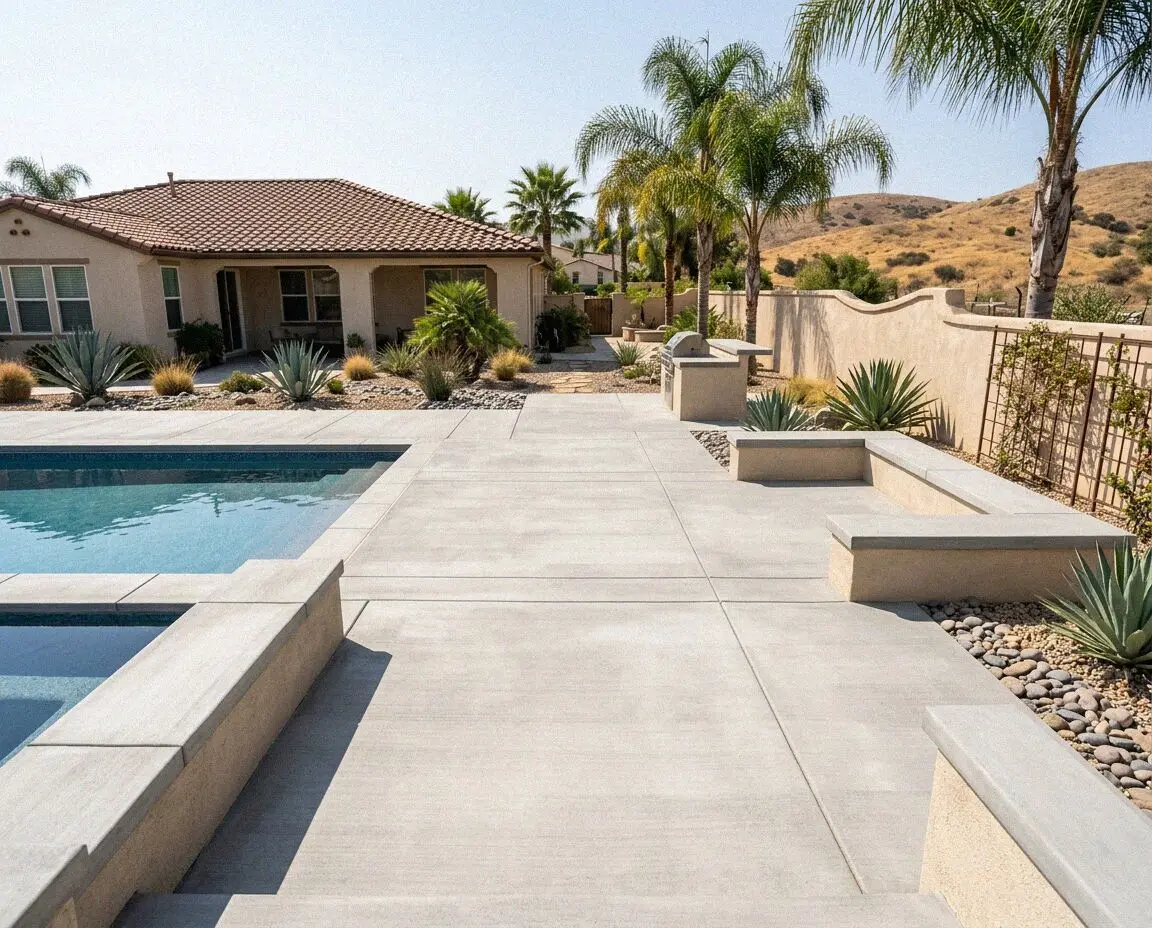
Stamped Concrete in Orange, CA, Patterned Along the Fall of the Yard

Plaza Orange Concrete stamps a patio, path or apron once the fall is shot and the pattern turned to run with it, as a slab that holds water goes white. Every estimate is measured and written on site.

Google reviewsFacebook reviewsBetter Business Bureau reviews5.0 Stars Rated by our customers · Google, Facebook and the BBB
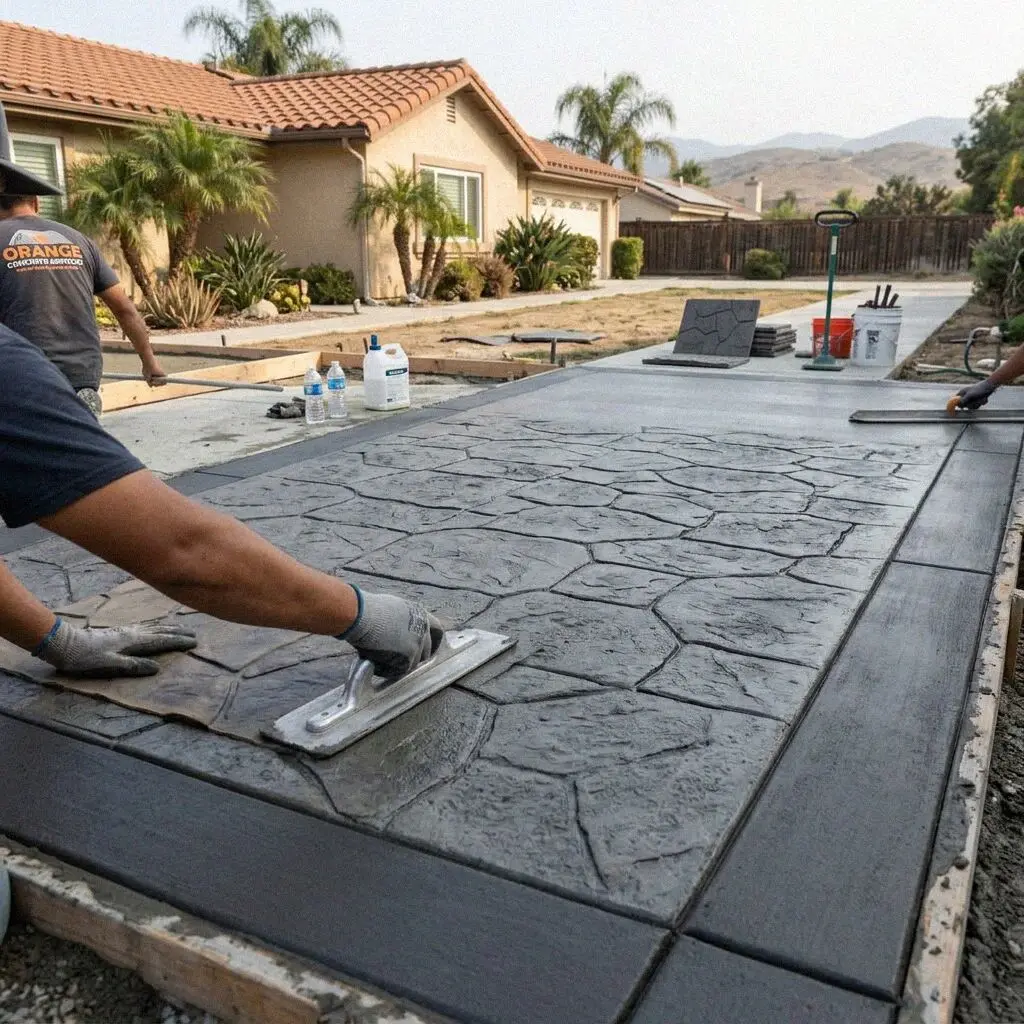
Crew pressing a slate stamp into a fresh patio slab behind a house in Orange
Hands lifting a stamp mat off fresh textured concrete at an Orange home

How the work is done

Stamping a Patio on an Orange, CA Lot

A stamped slab is a plain slab with a texture pressed into it while it is still soft, and the texture is where it succeeds or fails. Color hardener is worked into the surface, a powdered release goes on over it, and the mats are pressed in before the concrete stops taking a print. Every grout line in the pattern is a shallow channel. Run those channels with the fall and the slab sheds a storm in minutes; run them across it and each one holds a strip of water until the sun takes it.

Plaza Orange Concrete has stamped concrete in this city since 2018, and Curtis Ballard sets out the pattern on every job himself, after 18 years of flatwork on central Orange County crews before that. The pattern is chalked on the base with the fall already shot, so the first mat goes down square to the way the water will leave and the last lands where the slab meets the house. The crew works from the far corner back to the door, and nobody steps on a finished print.

The C-8 classification is held with the California Contractors State License Board in Curtis Ballard's own name, with liability insurance on every job. A stamped patio, path or courtyard on your own lot is exempt flatwork under the California Residential Code, so the only piece the city sees is an apron in the parkway, on the encroachment permit Public Works signs. The finish leaves with a written workmanship guarantee against defects in how it was built.

Redo or reseal

When does a stamped slab in Orange, CA need redoing?

White cloud in the sealer

A milky patch that shows up after the sprinklers run is water trapped under the sealer, and it collects where a grout line lies across the fall and holds a strip every night. Stripping and resealing clears it for a season. The line is still across the fall, so the cloud comes back.

Color gone in a path

A bare gray track from the back door to the gate means the color was a stain on the surface rather than a hardener worked into it, and feet have taken it off. There is no putting a hardener into concrete that has set. A tinted sealer hides the track for a year and then it is back.

Puddles standing in the pattern

Water still lying in the grout lines an hour after the hose is off is a slab that was stamped level, or patterned across its fall. Each puddle leaves a ring of mineral when it dries and lifts the sealer a little each time. On a flat lot in the west of the city that happens nightly.

A crack across a stone

Stamped concrete is meant to crack, along the joints hidden in its grout lines. A crack cutting through the middle of a flagstone means the joints were cut too far apart or not put in the lines at all, and it keeps opening. A patch shows through any pattern, so the panel is repoured.

In every stamped job

What Goes Into a Stamped Slab in Orange, CA

Eight things are in every stamped patio, path or apron at no separate line, and each one is there because of what this city's yards do with water. They pond on the flat sandy lots in the west, and they run straight off the graded pads in the east.

The old slab comes out

A stamped finish never goes over an old patio. The old concrete is broken out and hauled, so the new slab sits on ground and not on a crack.

The fall shot first

A level is run from the door sill to the lowest edge before the pattern is chosen, so the water has a way out and the pattern is turned to it.

Base compacted in lifts

4 inches of crushed base, plate-compacted in two lifts, because the rounded creek gravel under most of this city rolls rather than locks.

Color worked in, not on

A dry-shake color hardener is floated into the surface twice, so the color is in the top eighth of an inch and not a coat that wears through.

Pattern set to the fall

The mats are chalked so the long grout lines run downhill, each one a channel that takes water to the edge instead of a dam that holds it.

Joints hidden in the lines

Control joints are cut inside a grout line at 8 to 10 feet, so the crack the slab is going to make lands where the pattern already has a line.

Release washed, sealed

The powdered release is pressure-washed off on day two and the slab dried before a solvent sealer goes on thin, in two coats, never one thick one.

Walk-through and guarantee

We walk the finished slab with you with a hose running, so you watch it drain, and hand over the written guarantee before the truck leaves.

Four patterns

Stamped Patterns for an Orange, CA Yard, Compared

Four patterns we press most in this city, set against where the slab sits and how its grout lines handle water. The concrete, the base and the color hardener are the same under all four, so the table is about the texture and what it does once it is wet.

OptionSuitsGrout linesColorWet grip
Ashlar slateA rear patio on a tract lotStraight lines, easy to run downhillOne hardener, a darker releaseGood, the slate cleft holds a shoe
Random flagstoneA courtyard or an acre lot in Orange Park AcresWandering lines, laid out by hand to the fallTwo hardeners blended on the slabGood, deep texture between stones
Running bond brickA path or border beside a 1920s porchTight grid, cut as a border onlyA red hardener with a charcoal releaseFair, the face is smoother
Seamless texture skinA pool deck or a pad on a hill lot that fallsNone, so nothing to dam waterOne hardener, sealed matteFirmest, a fine even grain the whole way

Seamless skins cost least in labor and most in sealer over the years; a brick border adds a day for the second color. The fall under any of them cannot be changed.

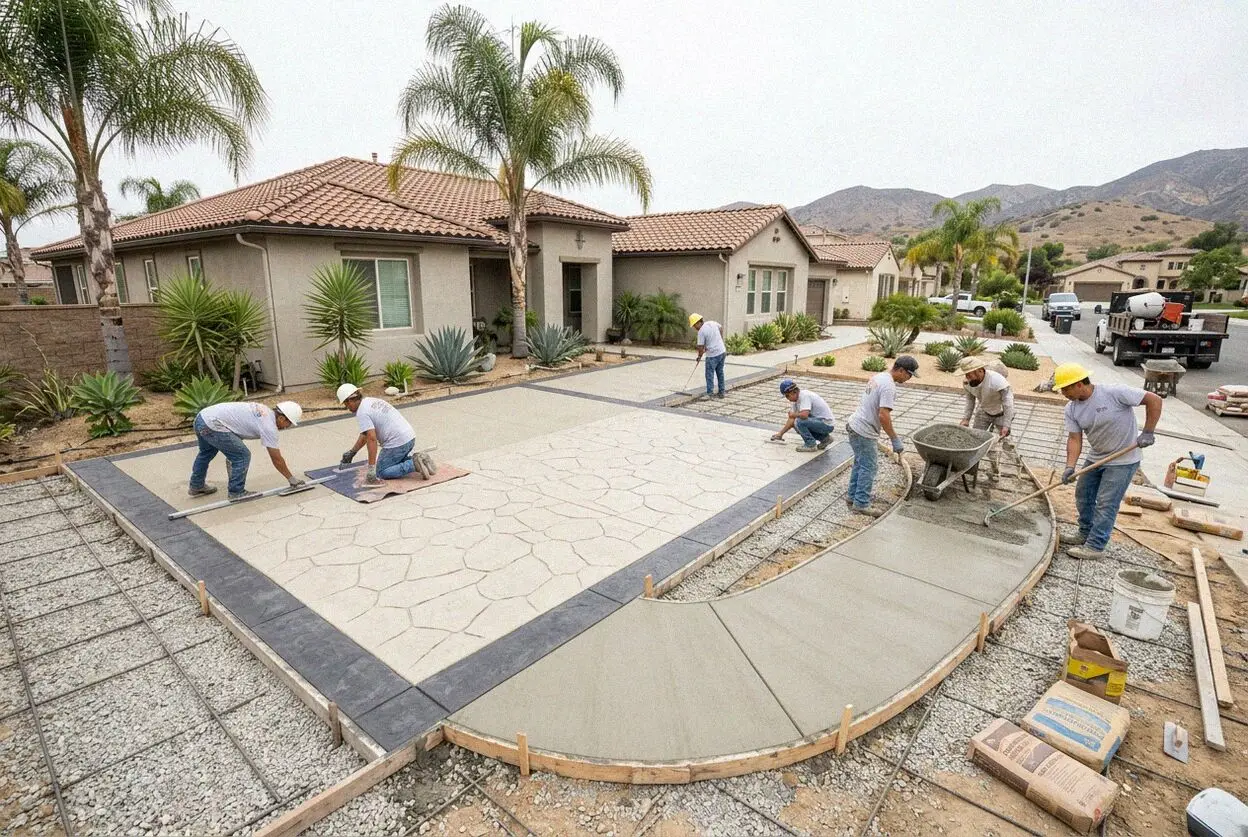
Concrete crew stamping a patio behind a house in Orange, CA

Water and the pattern

Why the Fall Comes First on an Orange, CA Slab

This city has two kinds of yard for a stamped slab, flat ones in the west that pond and graded pads in the east that run, and the pattern has to be turned to suit whichever one it is on.

Through the center and west, from the Plaza out toward the 57, the lots are flat and the ground under them is Santiago Creek wash, sand and rounded gravel. A slab there has to be given its fall, because the yard has none, and a stamped one needs more of it than a broomed one since the texture holds water a broom finish sheds. Sprinklers run most nights from May to October, so a grout line across the fall fills and dries a hundred times a summer, each time leaving a ring of hard water.

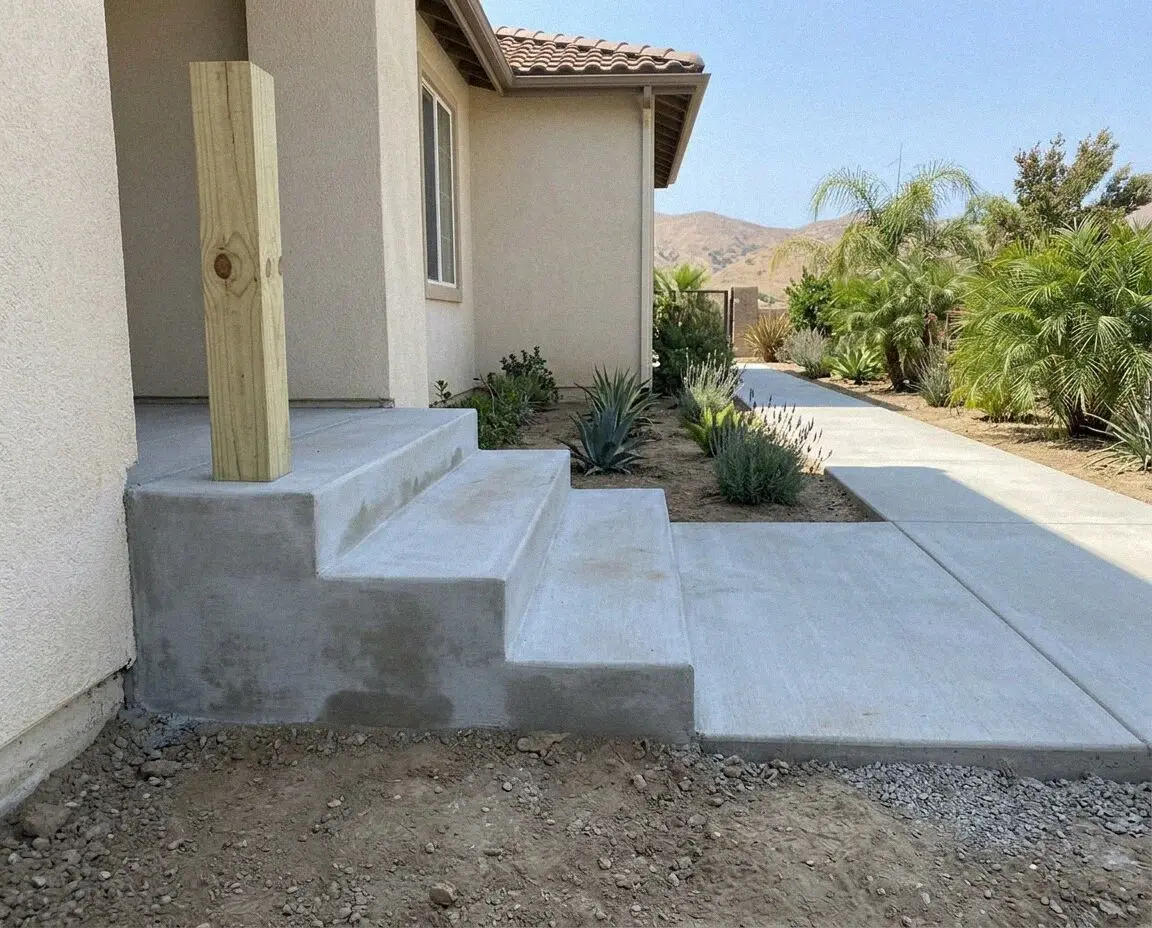
East of the 55, in Santiago Hills and the tracts above Santiago Canyon Road, the yard is a graded pad and the problem reverses. A slab there has fall to spare, and the risk is a pattern laid across it, where every grout line becomes a small dam that throws water sideways toward the house or the slope. On those lots the long lines run downhill and the slab finishes on a drain at the low edge rather than a lip. Where the pad steps, the step is poured with it as concrete steps.


From call to sealer

How We Stamp a Slab in Orange, CA

Five stages, and the person who shoots the fall on the first visit is the one who chalks the pattern on the base and presses the first mat. A pour is booked for a morning the marine layer has burned off by nine.

1

Shoot the fall, open the ground

Curtis Ballard runs a level from the sill to the low edge, opens a test hole, and lays sample mats where the slab will sit. The figure is written.

2

Pick the pattern, color and week

You choose the pattern from mats seen in your own light and the hardener from cured samples, then take a date. An apron is filed with the city.

3

Break out, dig, compact base

The old slab leaves in a day. The ground is cut to the fall the level set, and 4 inches of crushed base goes in, plate-compacted in two lifts.

4

Pour, color, press the mats

The truck is on site by seven, the hardener is floated in twice, release is broadcast, and the mats go down the chalk lines from the far edge in.

5

Wash, cut, seal, hand over

Joints sawn in the grout lines on day one, the release washed off on day two, the sealer on thin once the slab is dry. Paperwork on the walk.

Behind the number

What Sets the Estimate on a Stamped Slab in Orange, CA

Square footage starts the figure, and the fall and the pattern finish it. A patio needing 3 inches of cut to drain is a different job from one that only needs forming, so nothing is quoted off a photo. Every estimate is measured and written on site.

A rear patio on a tract lot

A single slab off the back door on a flat lot is the plainest job here. What moves it is how much cut it takes to get a fall the yard lacks.

A condo or townhome courtyard

Shared walks and courtyards in the complexes off Chapman and Tustin need the HOA's sign-off and a crew working around residents, which adds days.

An acre lot with a long approach

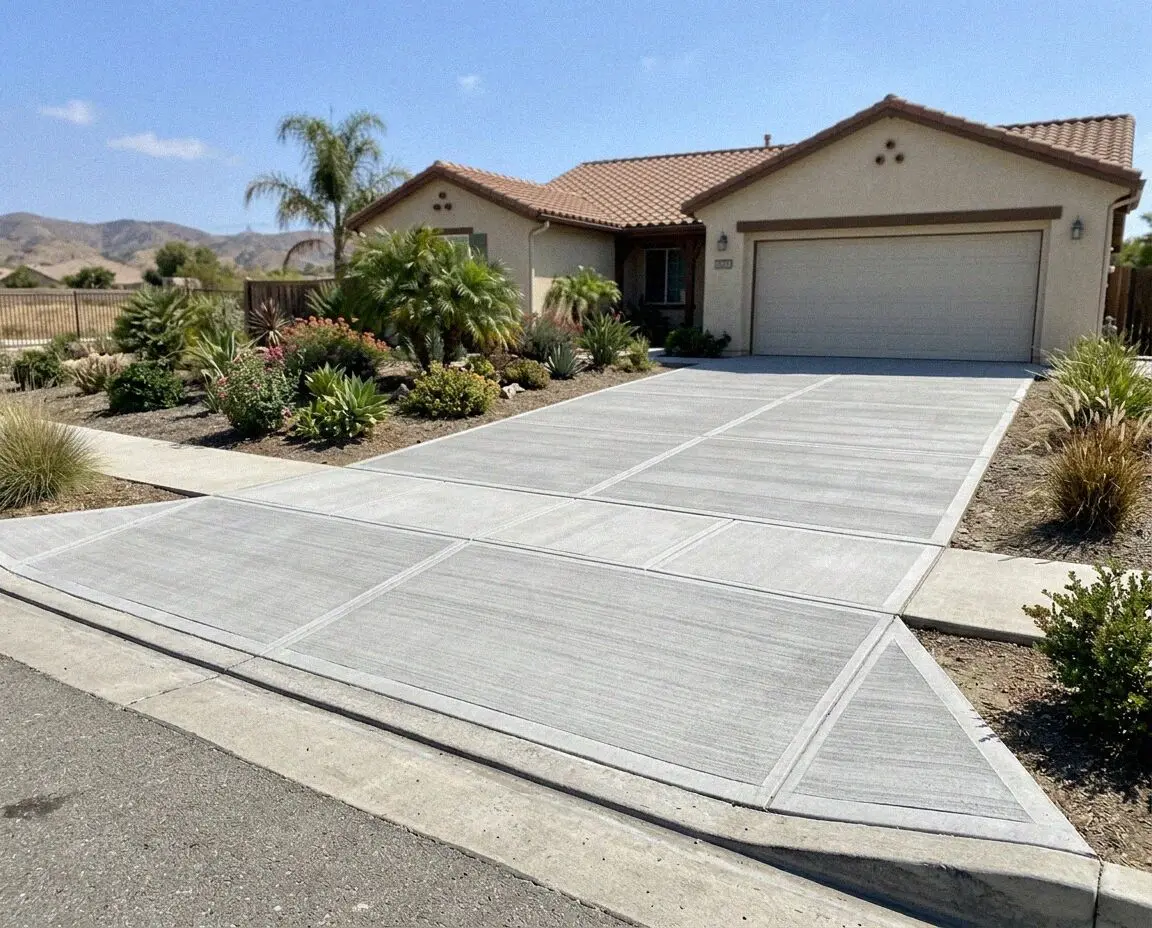
A stamped approach on an Orange Park Acres lot runs to hundreds of feet, poured whole or phased, with a horse trailer standing on it at the end.

Two colors and a border

A second hardener, a contrasting border in another pattern, or hand-antiquing the stones adds a color day and a second set of mats to the job.

The visit and the written figure cost nothing, and the call to arrange it comes within 1 business day. (657) 236-3410 or send us a message.

Ready to have your Orange, CA yard measured for a slab?

Send the form or call, and someone rings back within 1 business day to fix a time. Curtis Ballard shoots the fall, lays the sample mats where the slab will sit and writes the figure at your house, and you are free to sit on it.

Request a Free Estimate

Written on site · No obligation

By submitting, you agree to our disclosure and consent terms, including being contacted by Plaza Orange Concrete.

Slabs we stamped

Three Stamped Slabs in Orange, CA, in Their Owners' Words

Three reviews from Google, Facebook and the BBB, each about a stamped slab rather than a plain one, and each about how it took water afterward, which is the only test that counts.

Google review

“Our old patio in Santiago Hills was stamped flat and went white every summer. Curtis cut 2 inches out at the far side, ran the slate pattern downhill to the drain and it has been a full year without a puddle. The sealer still looks like it did on the day.”

Priya M. of Santiago HillsStamped patio replacement · Google · 2024
Facebook review

“We have an acre in Orange Park Acres and wanted the drive up to the barn stamped in flagstone. It was poured in three sections over two weeks, and the joints are inside the grout lines so you cannot find them. The trailer has gone up and down it all winter.”

Tomás R. of Orange ParkFlagstone drive to the barn · Facebook · 2022
BBB review

“The path round our house in El Modena got a brick border and a slate field. The crew chalked the whole thing out on the base before the truck came so I could see where every line went. Two winters on and the water still runs straight off to the side yard.”

Gwen L. of El ModenaStamped path with brick border · BBB · 2025

Before you book

Stamped Concrete Questions Asked in Orange, CA

What moves the figure, how long the yard is out of use, what the sealer is and who has to sign anything, answered for a stamped slab on a lot in this city.

(657) 236-3410
  • Why does one stamped patio come in higher than another?

    The fall, the pattern and the color, in that order, once the size is known. A flat lot in the west of the city can need 2 or 3 inches of cut along one side before the slab can drain, and that soil leaves in a truck. A random flagstone takes a day longer to lay out than an ashlar grid, and a second hardener or a border adds a color day. All three are measured at your house and printed on the sheet you sign.

  • How many days does a stamped patio take in Orange, CA?

    Four working days for a rear patio, then a week before furniture goes back on it. Day one breaks out and digs, day two sets base and forms, day three pours and stamps, and day four washes off the release and cuts the joints. The sealer goes on once the slab is dry, which in June can mean waiting for the marine layer to lift. Feet are fine after 48 hours; the table and the barbecue wait the seven days.

  • Is the sealer included, or is that a separate job?

    It is in the figure, both coats, and so is the release wash before it. A stamped slab handed over unsealed is unfinished, since the release color is only held in the texture by the sealer, and the first rain would take half of it. What sits outside the figure is named on the visit rather than added later: a drain run to the street, a fence panel out for the truck, or a resealing coat in later years.

  • Does a stamped patio need a permit from the city?

    Not on your own lot. A patio, path or courtyard slab is exempt flatwork under the California Residential Code, so nothing is filed for it and no inspector comes. Two exceptions apply here. A stamped apron crosses the parkway, which is right-of-way work permitted by the Director of Public Works, and a slab the street can see on a lot inside Old Towne falls under its design standards, which we put to Planning first.

  • Will insurance pay to replace a stamped slab that failed?

    Almost never for the failures a stamped slab actually has. Clouded sealer, worn color and a crack off the joint lines are treated as wear or workmanship, and a policy covers neither. What it can cover is sudden damage: a tree coming down on the patio, a burst irrigation main washing the base out, a vehicle onto the apron. Photograph the slab before anything is broken out and ask your carrier first.

  • What does the guarantee cover on a stamped finish?

    How it was built: the fall, the base, the depth, the hardener worked in twice, the joints inside the grout lines and the two coats of sealer, all printed on the estimate before you sign. It is a written workmanship guarantee against defects in how it was built. Sealer wear, tire marks, a stain from a planter left standing, and ground moving beyond what the joints control sit outside it.

  • Which color hardener and sealer go on the slab?

    A dry-shake color hardener from a named manufacturer, applied at the maker's rate in two floats, over a 3,500 psi mix with fiber through it, and a solvent-based acrylic sealer in two thin coats. The hardener brand, the color name and the sealer are written on the estimate, so what comes off the truck can be checked against the sheet. The mix is not tinted through, since integral color alone stamps shallow.

  • Do I need to be there while the slab is stamped?

    Only at the start and the end: the first visit, when the sample mats go on your lawn and the color is chosen, and the walk-through, when the hose is run on the finished slab. Between those the crew needs water, a gate that opens and the back yard clear of furniture, pots and the dog. The stamping is a morning's work that cannot be paused, so nobody is free to talk until the last mat is lifted.

Towns we pour in

Stamped Concrete Around Orange, CA

The eight nearest towns on the coverage list, each with the straight-line distance from the yard on N Tustin St beside it. The fall is shot and the figure written at the property, whichever town it is in.

Show All Areas We Serve

Book a free measure of your Orange, CA patio

Call or send the form and you hear back within 1 business day. Say which way the yard slopes, if it slopes at all, and which pattern you have been looking at, and the visit can be booked for a day inside the same week.